
At Ease with Easements
A Libertarian Case for Easements

Why Are We Arguing About Easements?
We are talking about easements because Dave Smith, halfway through his appearance on the November 18, 2025 episode of the Biblical Anarchy podcast,1 brought up the topic and rejected the idea that libertarians had successfully made a valid argument for easements from libertarian principles.
There have been multiple arguments given that attempt to justify easements under libertarian theory, but Dave is apparently unimpressed with these arguments. Instead, Dave states that coming across the alleged justifications for easements under libertarian theory was the first time he thought “that was kind of bullshit”, and that libertarians just “yada yada’d” over a “whole contradiction” to their theory.
On Dave’s view, the position that genuinely follows from libertarian principles is that the crossing party has no right to an easement at all. The property owner, he maintains, is fully justified in excluding others from his or her property—even when doing so prevents the excluded party from returning to their own property, from homesteading unowned land, or from accessing the property of another who has granted them permission to enter.
Dave does not deny that this has undesirable consequences. On the contrary, he explicitly acknowledges that the absence of easements would likely result in war and death, and since peace is preferable to conflict, he suggests that libertarians have effectively added easements into their theory not because they genuinely follow from libertarian principles, but because the theory looked far worse without them.
I take the broader point Dave is making to be this: libertarian theory already contains a number of ad hoc additions that do not strictly follow from its foundational principles, but instead function to patch over the undesirable consequences those principles generate when applied consistently. If libertarians are already willing to accept such additions in order to avoid unacceptable conclusions, then Dave asks why the same strategy should not be applied elsewhere—such as in debates over immigration or public property—where, he claims, similarly troubling conclusions arise from libertarian principles when taken to their logical endpoint.
My intention is not to argue whether libertarian principles when applied to immigration and public property would result in unacceptable conclusions, or whether such a conclusion would justify altering or setting aside libertarian theory—for those interested in such arguments, I would direct them to my earlier piece where I address the immigration issue.2

For now, let us stick to the issue of easements and whether Dave is correct that there can be no case made for easements using libertarian principles, or at least a case to be made for why one ought not view easements as contradicting libertarian principles.
Three Test Cases for Libertarian Easements
Here, ‘easement’ refers to the ability for one party to travel across the property of another—even against that owner’s wishes. It is typically employed in situations where crossing the property is necessary for the crossing party to (a) return to their owned property, (b) access unowned property open to homesteading, or (c) access the owned property of another for which they have permission to enter.
Let us sketch out three different and distinct examples used by libertarians to illustrate the sort of scenarios we have in mind. As far as I am aware, of the three scenarios, one originates from Walter Block, another from Ace_Archist, and the last from myself. They each offer a slightly different case of easements, and each have a slightly different argument given for why libertarians should regard the easement as justified and valid.
The first case is the one most frequently cited in the literature, and accordingly much has already been said about it. For that reason, a substantial portion of the discussion will be devoted to analyzing the various arguments offered both for and against easements in that context. The insights gained from this analysis will then be applied to the remaining two examples in order to assess how far the pro-easement argument can be extended.
1. Donuts, Bagels, and Unowned Land: The Setup
The most common example used comes from Walter Block. The example goes something like this:
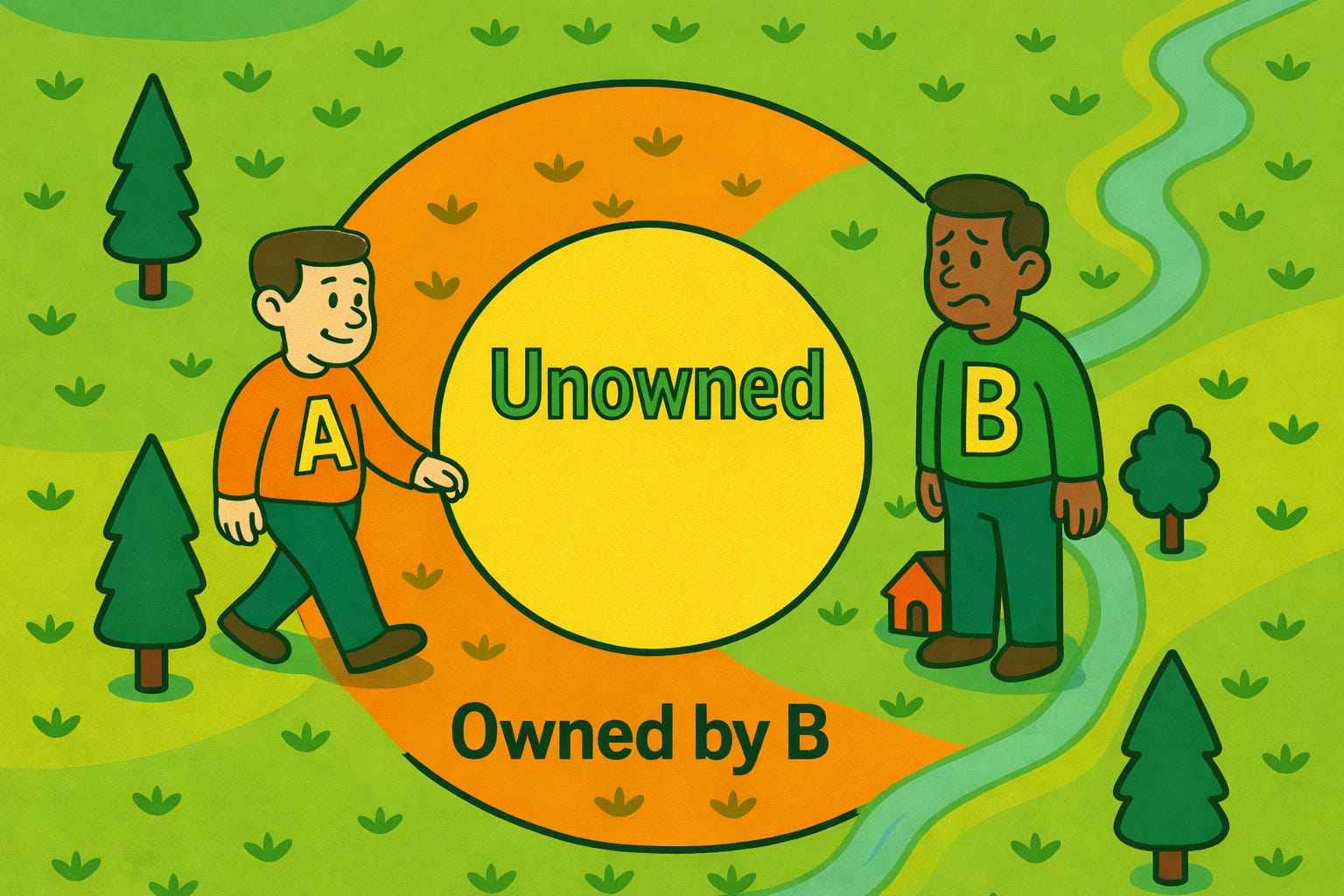
Imagine that B has homesteaded some section of land that is shaped like a donut, but left the center unowned.
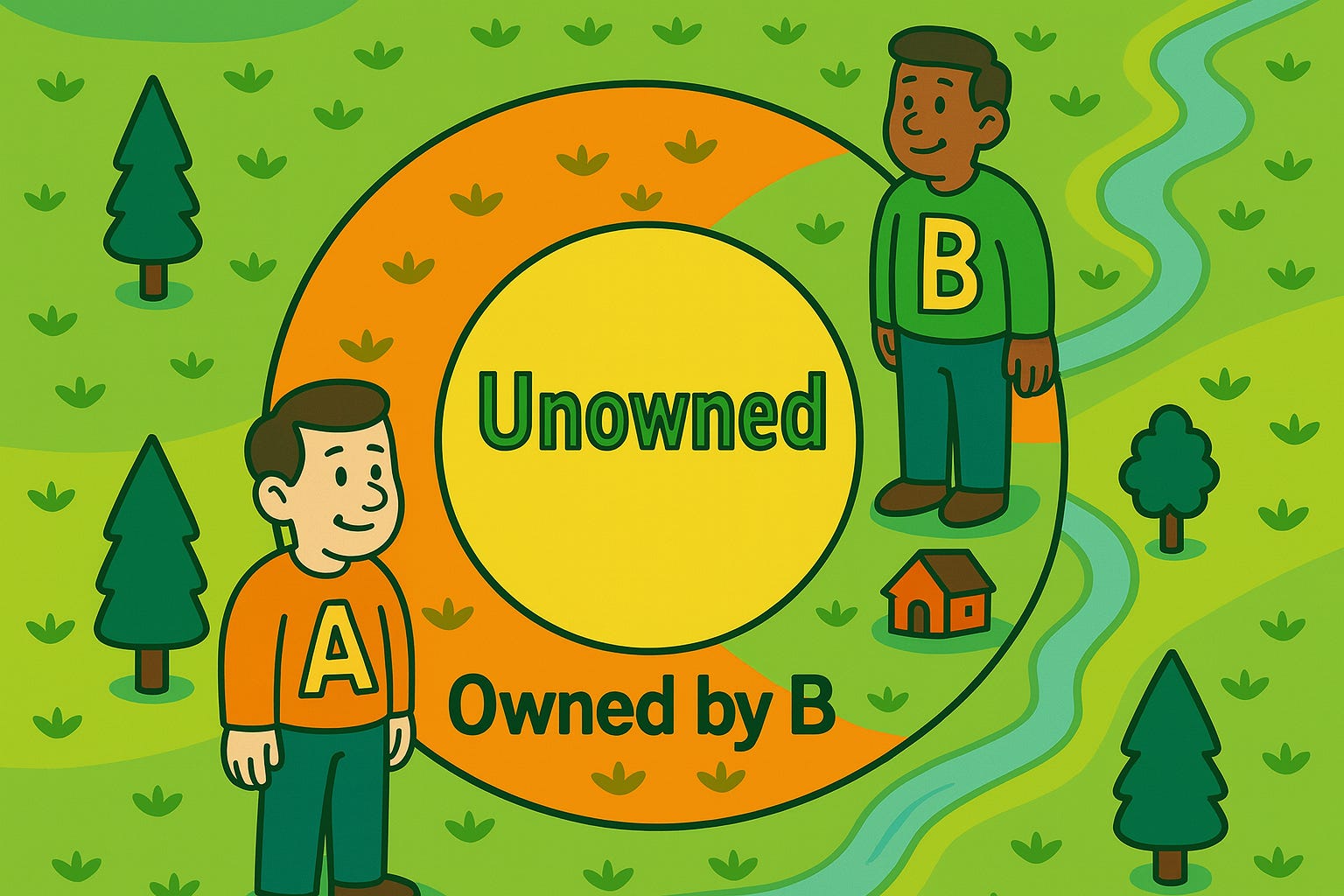
A comes along to the property border in an attempt to homestead the unowned resources in the center of the donut, but B refuses to grant A permission through his land.
Is it permissible for A to cross B’s property in order to homestead the unowned resources at the center?
2. Gusts of Wind and Owned Land: The Setup
The next example comes from Ace_Archist and goes as follows:
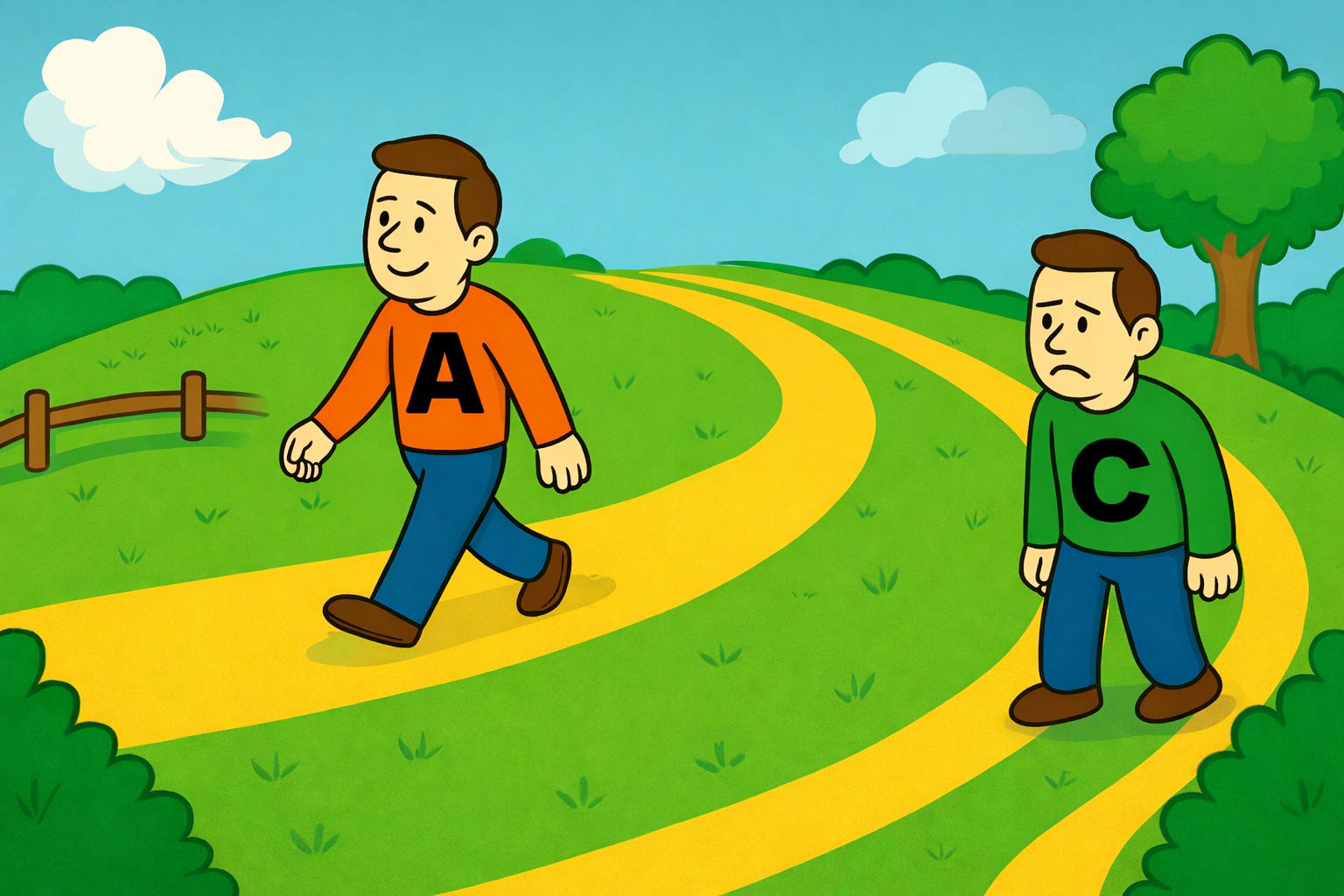
Imagine a gust of wind blows A onto the property of B.
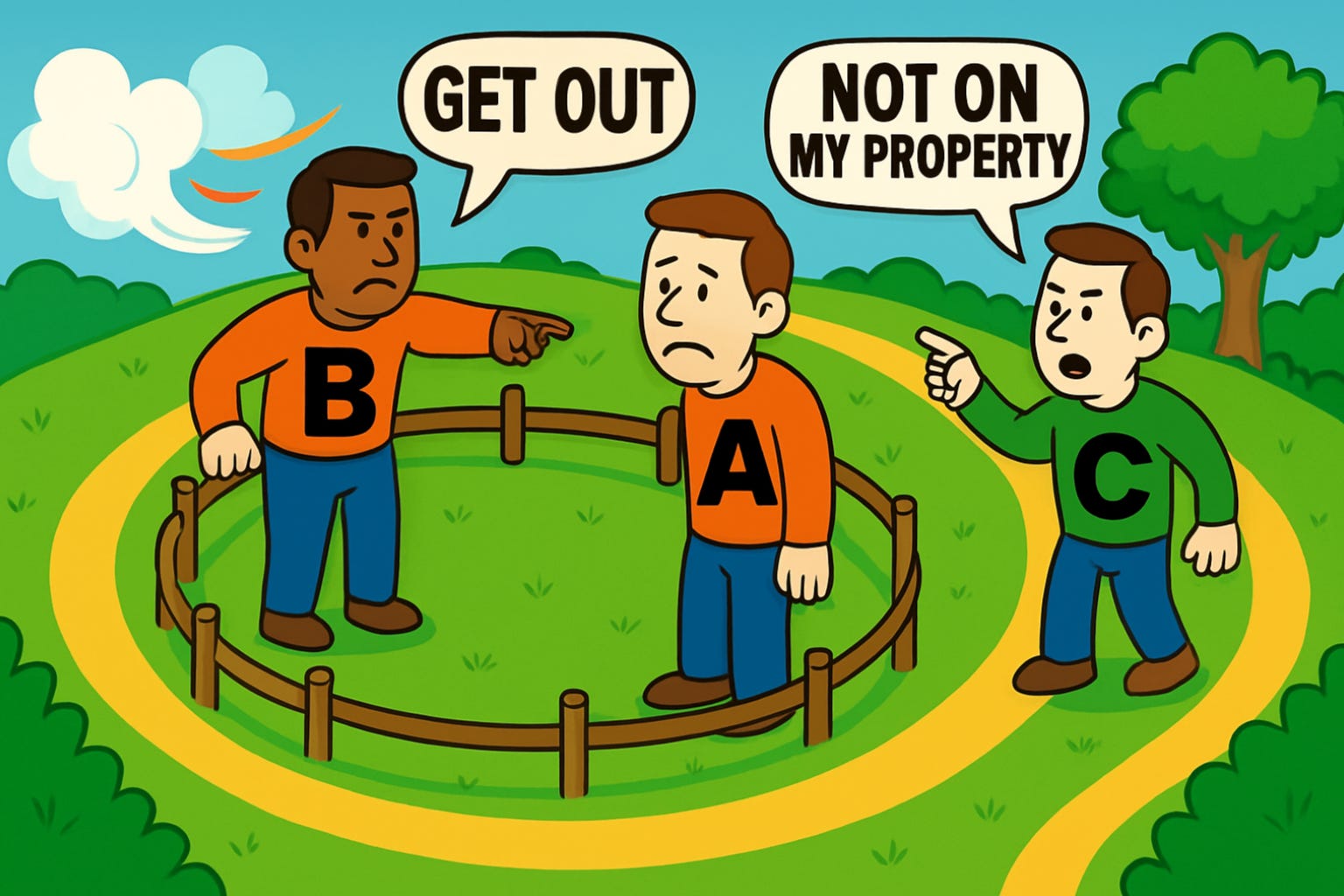
B orders A to leave his property—something within his rights as the owner—but in order to leave B’s property, A must necessarily cross onto C’s property3, but C has forbidden A from setting foot on his property.
Is it permissible for A to cross C’s property in order to leave B’s property?
3. Couches and Restricted Enslavement: The Setup
The third example—as far as I am aware—originates from me. The scenario goes like:
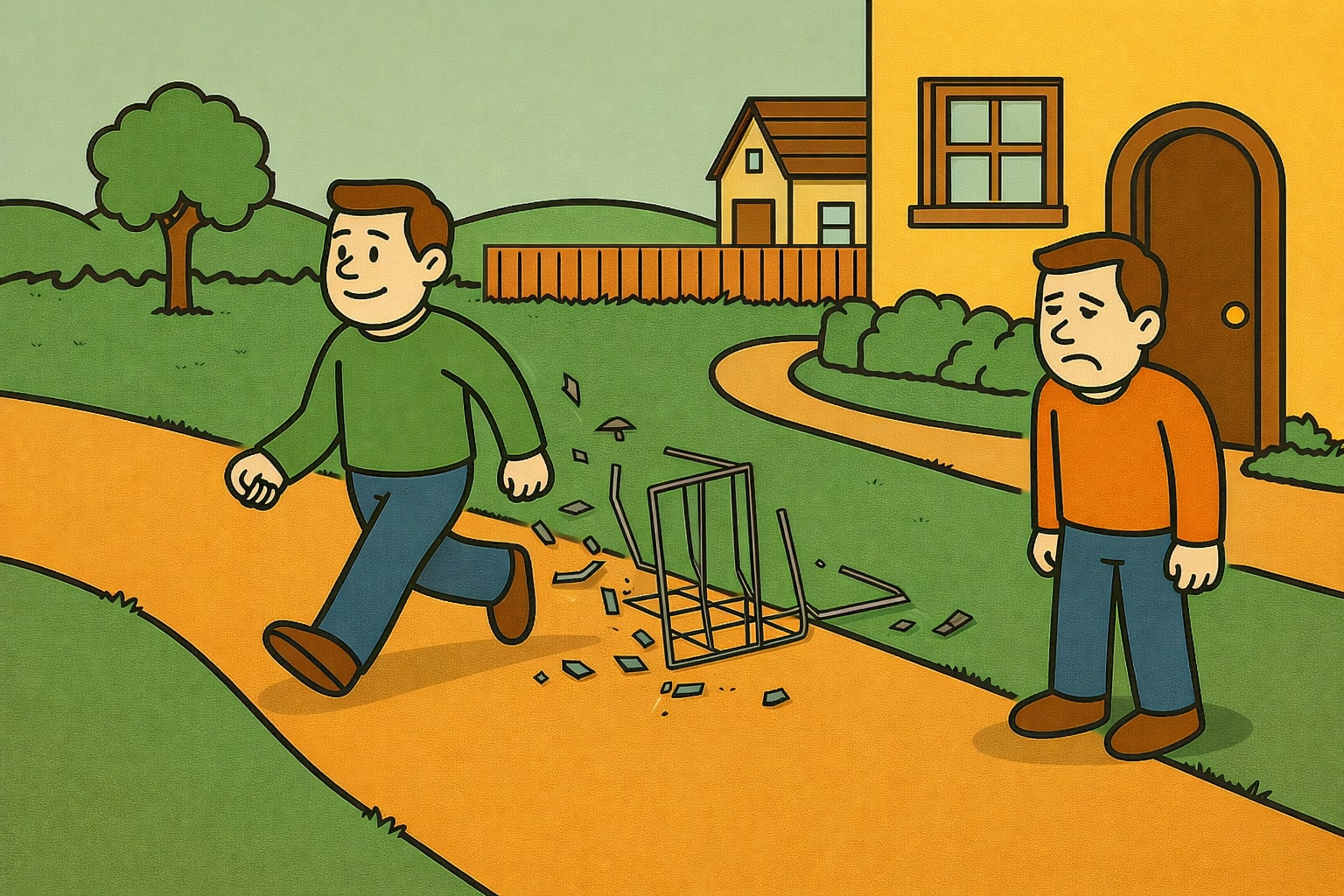
Imagine A has been invited into B’s property.
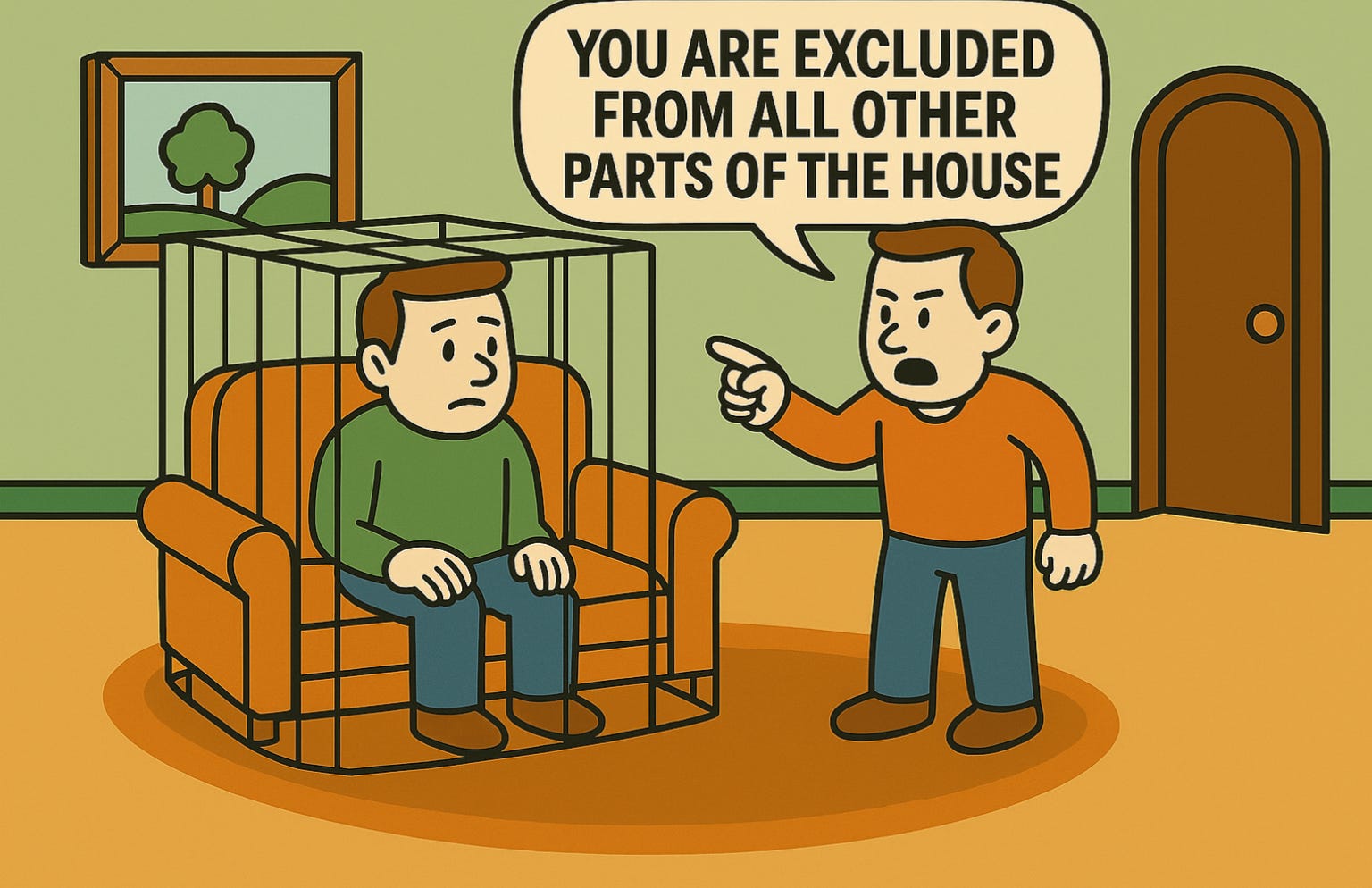
A sits on B’s couch in the middle of B’s living room. As A does this, B announces that he is enacting his right to exclude A from all areas of his house except for the couch. Thus, as it currently stands, A is not committing any rights violations, but would commit one the moment he got up off the couch to do anything—from returning to his home to attempting to get food or water.
Is it permissible for A to cross B’s property in order to leave B’s house and return to his own property?
Why You Might Be Inclined to Say No
While each of the above cases has their own unique argument given for why they should be regarded as justified under libertarian theory, libertarian opponents of easement typically offer one argument against easement. To say that A is the owner of X is to say A has a right to X, and A having a right to X means that A is justified in excluding others from X in order to continue their incorporation of X.4 From this, the opponents of easement argue that since each owner has the right to exclude another from their property, then there is no reason why an owner would not be able to exclude the crossing parties from their property.
An Exception for Aggression
Of course, there is one exception all libertarians make—though they differ in how they justify the exception.5 No libertarian would reject that it is permissible for me to use your property if doing so is necessary to end some aggressive act on your part. For example, I cannot take your gun when it is sitting on your table and you have made no threat with it, but I can certainly take your gun when you are actively trying to shoot me and/or other innocent people with it.
Since it is standard in libertarian theory to acknowledge one can use the property of another—even without the owner’s consent—when doing so is necessary to stop some aggressive act of the owner, one potential avenue for proponents of easement to go is to claim that denying easement is a form of aggression, and since one can use another’s property to end the owner’s aggression, the crossing parties are justified to cross in this way.
Or, put another way, libertarians are in agreement that there are no default positive obligations, so if one is to argue that sometimes one is obligated to allow people to cross their property, it cannot merely be framed as a positive obligation, but instead it must be shown that allowing the crossing party to cross is an obligation stemming from their negative obligation not to aggress.
1. Donuts, Bagels, and Unowned Land: An Analysis
Returning to the case of unowned land blocked off by a donut-shaped property, we can see how the opponents of easement would analyze this case. B, the owner of the surrounding ring, has the right to exclude A from his ring. The fact that excluding A from the ring prevents A from homesteading the unowned interior is irrelevant unless we can make a sufficient case that this amounts to aggression on B’s part—that is, a violation of B’s negative obligations.
Do Libertarians Hate Unowned Property?
Walter Block argues for easement in the case of donut-shaped homesteads because “the whole purpose of homesteading is to bring hitherto unowned virgin territory into private property ownership,”6 and if one were to homestead a donut-shaped plot of land, the unowned interior would be inaccessible to potential homesteaders, and thus is at odds with libertarian theory unless we grant easements. As Block argues:
under the donut configuration assumption, even though the owner has duly homesteaded every square inch of his holdings, he still cannot claim full ownership to it in its entirety, for him to be able to do so would imply that the land lying inside (or outside!) of this area can forever remain unowned. Just as physical reality abhors a vacuum, so to does libertarian homesteading theory abhor land which cannot be claimed nor owned because of the land ownership pattern of the forestaller. This means that the owner of the donut shaped land must allow people at least a path across it so as to be able to homestead, on their own account, land that the forestaller has left unoccupied and unowned.
—Walter Block7
The idea that libertarian property rights have the built-in goal of turning all unowned land into private property is central for his argument to work, as it would mean that homesteading in the shape of a donut and not allowing people easement over the land would conflict with the purpose of libertarian property rights. Block reasserts this point multiple times:
The goal of the free society is, presumably, to convert all of nature into private property… One problem is that as long as B himself does not homestead this acreage, no one else can do so either, and it remains in a state of non-ownership. This, alone, is anathema to the libertarian ideal that all of the earth’s surface should come under private ownership.
—Walter Block8
However, this premise is controversial within libertarian theory. As Stephan Kinsella has argued—and as I agree—libertarian theory has no built-in goal to fully privatize the world, and has no abhorrence for unowned property.9 Libertarianism does not comment on whether everything should be privately owned, it merely states what can be privately owned—scarce resources—and the conditions under which ownership is legitimately acquired—the establishment of an objective link via direct control, original appropriation, or voluntary transfer/exchange from a title chain linking back to original appropriation. The fact the donut-shaped homestead may prevent the interior from ever being owned does not entail a contradiction with libertarian principles because libertarian principles make no claim that their consistent application must result in a fully privatized world.
Controlling What You Have Not Homesteaded
Luckily, Block gives another argument which attacks the problem from another angle. According to Block:
In addition to not allowing all property to come under private ownership, this pattern violates yet another principle of libertarian homesteading: that no one may control land he himself has not homesteaded.
—Walter Block10
According to Block, because passing through B’s property is necessary to homestead the unowned interior, and B is excluding people from crossing over his property, B has in effect taken control over the unowned interior. However, he has not mixed his labor with the interior, and thus has no claim of ownership over the interior, and thus no right to control it in the way that he does.
I see multiple problems with this particular argument. For one, it is simply not true that no one may control land he himself has not homesteaded. Homesteading is not the only valid way to acquire ownership or justified control over a resource, I can also justly control the property I obtained via voluntary exchange. Beyond that slight semantic point which can be corrected by merely adding the qualifier “or obtained via voluntary exchange from a chain there’s no justifiable reason to suspect did not originate through homesteading”, I can take property under my control that I am not even the owner of, so long as the owner consents to my control. This is because, contrary to Blocks claim, I can control resources I have yet to homestead, but I cannot control resources that are not being used to aggress against me that others have already homesteaded without their consent.
Furthermore, it is questionable whether it is accurate to say B is “controlling” the unowned interior. All B is doing is preventing people from crossing his property. To do this, he certainly must have control of his property, but this does not necessitate that he is controlling the unowned interior in any meaningful way. In addition, I agree with Kinsella that the reason we obtain ownership of the unowned resources we mix our labor with does not bottom out at “because we mixed our labor with them” but rather results from the fact that mixing our labor with it establishes an objective link between us and the resource. As such, even if it is true that B is controlling the unowned interior without mixing his labor with it, this does not itself mean that B cannot have any ownership claim over it, because if he is truly controlling the interior in anything but a Pickwickian sense, then he has arguably established an objective link between him and the interior without mixing his labor with it.
This seems more at odds and problematic for libertarian theory, as it would result in a way for an actor to acquire ownership over a scarce resource external to the body other than mixing their labor with it, and while I go the Kinsellian route of saying mixing labor with a resource conveys ownership over the resource not due to the mixing of the labor but due to the establishment of an objective link, I still want to say that the only way to establish an objective link with an unowned resource external to the body is by mixing your labor with it. This argument would counter that claim. So, I think it is wise to maintain that B is not necessarily controlling the unowned interior merely by excluding people from his property.
Is It Actually Unowned?
Perhaps I am wrong, and it is the case that this Pickwickian sense of control is sufficient to establish an objective link between B and the interior. LiquidZulu is a proponent of this line of argument. This argument, if successful, would eliminate the need for easements entirely. According to Zulu, because the interior is enclosed by B’s property, and B is excluding A from the interior, B thereby becomes the owner of the interior.
As Zulu puts it:
It is the very nature of property itself that the owner excludes others from using it, we can then say that Crusoe in excluding others from accessing this previously unowned territory, thereby becomes its owner. It is this act of exclusion which is Crusoe initially directing the use of both the donut and the donut-hole.
—LiquidZulu11
It is true that owners have the right to exclude people from their property in order to continue their incorporation of the property into their ongoing projects, and it is the case that by excluding everyone from the ring—his property—he is excluding people from accessing the interior, but it remains to be seen if this exclusion is justified or if he is only justified in excluding people from his property who are not intending to go homestead the interior, or, put another way, if he is only justified in excluding people from his property in ways that does not exclude them from property he does not own.
Furthermore, it is not the case that excluding someone from an unowned resource conveys ownership of the resource to you. Exclusion does not generate ownership; rather, ownership is what generates the justification for exclusion. The question to be answered here is whether the owner of the circular ring is justified in excluding others from the interior. We cannot simply say that he is the owner merely because he excludes others. The justification for one’s act of exclusion depends on prior title to the resource. The exclusion itself does not generate a title in virtue of the fact that the spatial configuration of some owned property emborders unowned resources.
To make this explicit, imagine a scenario where a person is being excluded from homesteading some parcel of land not because doing so requires crossing some unpersuadable owner’s land, but because someone behind them has pointed a gun at them and ordered them to cease their current actions or else. This person clearly has no right to do this, yet if excluding a person from a parcel of unowned land meant you acquired ownership over the land, then not only would he have the right to do this, doing so would grant him ownership over the land.
This route would also seem to run Zulu into problems when applied to his solution to homestead stalemates—a situation where two actors attempt to incorporate an unincorporated resource into their ongoing projects simultaneously.
On this scenario, Zulu states:
Such a stalemate situation may turn into a conflict if either Crusoe or Friday forcefully excludes the other from completing their homesteading of the stick. This is a situation of the forceful one, say Crusoe, excluding the other from that which he does not own. This is an invasion from Crusoe against Friday, therefore Crusoe is the aggressor and not the proper owner of the stick.… Thus to forcefully exclude the other in a stalemate situation is to disqualify yourself from ownership of the good under stalemate, thereby ceding ownership to the other.
—LiquidZulu12
The very phrase, “excluding the other from that which he does not own” and the framing of this as aggression would imply that merely excluding someone from an unowned resource does not convey ownership. Furthermore, at least in this case both parties are attempting to incorporate the same resource into their ongoing projects, but this is less clear in the donut example. It is true that B is “controlling” the unowned interior if we broaden our conception of control to include, “preventing people from accessing it” but, as I have already pointed out, this is not due to him directly using—or controlling—the resource; rather, it’s an implication of him using his own property which is undoubtedly under his control.
For the sake of illustrating the difference, let’s assume B uses the circular ring for farming, housing, and mining. There is a lot of activity going on in the circular ring. B is controlling and incorporating the resource into his ongoing projects in a very immediate and intuitively obvious way, and those ongoing projects can be easily identified. This does not extend to the interior, which we can stipulate has been left completely untouched by B. We can even stipulate that B has openly stated he has no problem with anyone homesteading the interior, as he acknowledges that he does not own it and wants nothing to do with it. His only demand is that no one homestead it by crossing his property. If someone could reach the interior by helicopter, he would not object. If someone could tunnel their way there, he would not object. If someone could teleport there, he would not object. It is simply stipulated that none of these options are available—not because they are inconvenient or impractical, but because, for one reason or another, such means of access are impossible.
I hold that the only form of property one truly has no say in owning, and which is therefore unalienable, is one’s body. All other property claims are alienable and thus disclaimable. If, then, we stipulate from the outset that B is openly ceding any claim he might have to the interior, it is difficult to see how anyone could convincingly argue that, despite his wishes to the contrary, B is nonetheless the owner of the interior.
Furthermore, Zulus solution seems to run into trouble when one accounts for the insight Long13 provided concerning how enclosures work on spherical spaces like a globe. If one encloses a section of a globe, it is ambiguous which side is “inside” and which is “outside.” In other words, if A fences off a small section of land containing a field on a globe, it makes just as much sense to speak of that fence enclosing the small field from the world as it does to speak of that fence enclosing the world from the small field. So, if creating an enclosure automatically conveyed ownership over what unowned resources are enclosed, then it would make just as much sense for a man to claim ownership over all unowned parcels of land exterior to the field after constructing a fence as it would for him to claim ownership of the field, since it is equally true that the fence encloses the field from the world as it is that the fence encloses the world from the field.
Contradictory Duties and Claims
While Block attempts to justify easement in the donut homestead example due to it contradicting the supposed principle of libertarianism that all unowned resources be, in principle, ownable, Lukasz Dominiak also maintains that failing to allow easement would result in a contradiction within libertarianism, but for different reasons. Dominiak sees the contradiction not with some principle concerning the status of land, but with the fact that a pro-forestalling conception of property rights results in situations where there are incompatible duties and rights, and thus conflicts are unavoidable.14 As property rights are supposed to be conflict avoiding and rationally consistent, any proposed system of property rights that results in unavoidable conflicts due to conflicting duties and rights must be abandoned in favor of one that does not suffer these flaws.
Dominiak builds his argument around the following version of the donut hypothetical:
Imagine a bagel-shaped plot of appropriated land. Assume Red owns this bagel-shaped plot, called A, B is an unappropriated hole-in-the-bagel plot of land, and Blue is the owner of a plot of land C outside the bagel.
—Lukasz Dominiak15
From this, Dominiak constructs the following argument:
because Red is not the owner of B and therefore does not have any rights to B, Blue by definition cannot have any correlative duties toward Red in connection with B;
because Blue has no correlative duties toward Red in connection with B, Blue also has no duty toward Red not to enter B. But,
because Red is the owner of A, Blue has all correlative duties toward Red in connection with A;
because Blue has all correlative duties toward Red in connection with A, Blue also has a duty toward Red not to enter A;
because Blue has a duty toward Red not to enter A, he therefore has a duty toward Red not to cross A;
because of the bagel-shape of the land, to cross A is to enter B;
because Blue has a duty toward Red not to cross A and to cross A is to enter B, Blue has a duty toward Red not to enter B, which contradicts (2).16
I will attempt to recreate this argument in a more formal manner so we can identify the premises generating the contradiction, and see which premises both sides would have to reject. The following argument is not identical to Dominiak’s, though I feel they both are getting at the same issue with the pro-forestalling view:
If the interior is unowned, then no one has a duty to not homestead the interior. (Seemingly implied by the definition of unowned).
The interior is unowned. (True by stipulation).
—> Thus, no one has a duty to not homestead the interior. (Sub-conclusion from 1 and 2).
If no one has a duty to not homestead the interior, then it is permissible to homestead the interior. (Implied by the definition of duty).
—>Thus, it is permissible to homestead the interior. (Sub-conclusion from 3 and 4).
The circular ring, B, is owned. (True by stipulation).
If the circular ring, B, is owned, then one has a duty to not enter B without consent. (Seemingly implied by definition of owned).
—>Thus, one has a duty to not enter B without consent. (Sub-conclusion from 6 and 7).
If one has a duty to not do X, then it is impermissible to do X. (Implied by definition of duty).
—>Thus, if one were to enter B without consent, then it would be impermissible. (Sub-conclusion from 8 and 9).
The owner of B has not given his consent for others to cross B. (True by stipulation).
—>Thus, it is impermissible to enter B. (Sub-conclusion from 10 and 11).
If doing X requires doing an impermissible act, then doing X is impermissible. (As it requires the impermissible).
If you homestead the interior, then you must enter B. (True by stipulation).
—> Thus, homesteading the interior is impermissible. (Sub-conclusion from 12, 13, and 14).
——>Therefore, it is permissible to homestead the interior and it is impermissible to homestead the interior. (Conclusion combining 5 and 15).
The conclusion here is a contradiction, which tells us something has gone wrong, as contradictions are necessarily false. To avoid the contradiction and to save libertarianism, we must reject one of the premises. Which shall it be? Here the pro-easement and anti-easement crowd will diverge.
The Anti-Easements Route
If one wants to maintain that there are no easements, then they would have to reject premise 1, that the interior being unowned means that no one has a duty to not homestead it. They explicitly want to maintain that you have a duty to refrain from homesteading the interior, even though it is unowned. Of course, they would maintain that this duty stems not from any parties ownership claim over the interior, but from B’s ownership claim over his strip. However, this is at odds with the libertarian conception of unowned resources. We need not go as far as Block and make the claim that libertarian theory hates unowned resources, but we can certainly say that libertarian theory defines an unowned resource as one that has yet to have a justified claim over it and is thus open to be homesteaded. In other words, unowned resources are by definition homesteadable, but donut shaped-homesteads result in the interior being unhomesteadable. Thus, rejecting premise 1 just replaces one contradiction with another.
Kinsella denies this point, claiming instead that:
I see no special status of the unowned property; it’s just property someone would like to go homestead. If they can’t reach it, it’s not the fault of those who have this resource surrounded.
—Stephan Kinsella17
The truth is somewhere in the middle of Blocks claim that libertarianism has the built-in goal of homesteading all unowned resources and Kinsella’s claim that unowned property has no “special status” within libertarianism as it is merely “property someone would like to go homestead.” I have already pointed out the flaws with Blocks position, so lets focus on Kinsella’s. The most obvious objection to his position would be pointing out that someone merely wanting to homestead Kinsella’s house would certainly not render it unowned, so it is simply not the case that unowned property is “just property someone would like to go homestead.”
Furthermore, something being unowned does not even automatically mean someone out there would like to make it their own, all it means is that it is open to having ownership claims made against it. How is it that we make ownership claims over unowned resources according to libertarian theory? We homestead the resources from a state of non-ownership to establish an objective link between us and the resource. Thus, since unowned resources are resources open to having claims made against them, and homesteading is how one makes these claims, unowned resources are also resources open to be homesteaded.
The Pro-Easements Route
The more promising path is to reject premise 7, the claim that “If the circular ring, B, is owned, then one has a duty to not enter B without consent.” At first glance this may not look promising either. The idea that one needs consent from the owner to use their property is certainly an important part of libertarian theory, so if we are to reject this premise, it must be done carefully. It would be a great error to remove either the concept of consent or the authority of the property owner entirely from the equation, rather, it should be met with the small qualifier that, “If the circular ring, B, is owned, then one has a duty to not enter B without consent—unless such passage is necessary to end some aggressive act committed by the owner of B—such as forestalling you from your own property, from property you have been invited to, or from unowned property.”
Why should we regard forestalling as an act of aggression? Well for one, doing so saves libertarianism from contradiction—which is a big plus—but beyond that, because in either the case of owned resources or unowned resources, the forestalling is using the threat of force to deprive you access to things you have no duty to not access, and for which they have a duty to not prevent you from accessing with force. This may be seen most clearly in the case of your own property, as if someone were to deprive you access to the resource through force, then they have forcefully ended your incorporation of the resource into your ongoing projects. They may not have taken the property from you by incorporating it into their ongoing projects, but they have nevertheless deprived you of your property through force or the threat of.
Multiple Owners
Before we move on and extend our prior analysis to the two other examples, there is one other variation of the donut example regularly given and discussed. What if, rather than one person owning the surrounding ring, it is instead made up of a multitude of owners, say B-Z? Does A still have easements over B-Z’s property? I, and the others who adopt the pro-easements position, are inclined to think A still has easements, but there is some disagreement over which property A has easements over. Both Long18 and Block19 seem to take the position that A can cross over the land of whatever owner he chooses, so long as the owners have not gotten together and come up with some alternative.20 However, Lukasz Dominiak takes a different position, arguing instead that A has easements over the property that actually finalized the enclosure of the donut and generates the necessity for easements to begin with21. So, if B-Y had been there for years, and then Z comes along and homesteads a chunk of land that then forms a fully enclosed ring with the other peoples property surrounding unowned land, then A has easements over Z’s property to get to the unowned land, and Z’s property only. Dominiak does qualify that if this was all done simultaneously by B-Z, or even M-Z, then A would have easements over all of B-Z or M-Z respectively.
I am tempted to adopt Dominiak’s position, the one wrench I can see being thrown in its gears is that if we adopt the view I have laid out where refusing to allow passage amounts to aggression, then it becomes harder to see how B-Y are not committing aggression by refusing to allow passage to resources they have a duty to not prevent people from accessing. The actual logic used in the prior arguments concerning contradictory rights would seem to imply the rights would contradict whether you were the owner who enclosed the ring or not, as what matters is that the crossing party has no duty to not homestead the interior, and you have a duty to not prevent them from homesteading unowned resources. Though Dominiak seems to imply otherwise.22
2. Gusts of Wind and Owned Land: An Analysis
I have just argued that easements must be incorporated into libertarian theory as the failure to do so entails contradictions, but the specific scenario I used involved easement into unowned property, can we extend this analysis to the two other scenarios I have laid out? I believe so. Let’s continue to the gust of wind example.
Recall that in this scenario, A has been blown by a gust of wind onto B’s property. B has ordered A off his property, but B’s property is surrounded by C’s property, and C has ordered A to not set foot on his property. If we fail to state that A has the right of easement over C’s property, then we are once again left with a contradiction. B has ordered A off his property, and thus A has a duty to leave B’s property. However, because B’s property is completely enclosed by C’s property, the act of leaving B’s property is equivalent to the act of entering C’s property, and because C has exercised his right to exclude A from his property, A has a duty to not enter C’s property. However, we have just said that A has a duty to leave B’s property and also a duty to not enter C’s property, and we have just said that A leaving B’s property is equivalent to entering C’s property, and so we are again left with a contradiction, that A has a duty to do X, and a duty to not do X.
Or put as a formal argument:
If a property owner orders someone to leave his property, that person has a duty to leave (seemingly implied by definition of owned).
B has ordered A to leave B’s property (true by stipulation).
—> Thus, A has a duty to leave B’s property (sub-conclusion from 1 and 2)
If a property owner orders someone to not enter their property, then that person has a duty not to enter (seemingly implied by definition of owned).
C has ordered A to not enter C’s property (true by stipulation).
—> Thus, A has a duty to not enter C’s property (sub-conclusion from 3 and 4).
The act of stepping off B’s property is identical to the act of entering C’s property (true by stipulation).
— —> Therefore, A has a duty to do and not do identical acts. (conclusion from 3, 6, and 7).
This conclusion is a contradiction, so again, something has gone wrong either in one of the premises or the reasoning. I do not believe the argument is invalid, so the problem must lie in one of the premises. Which one?
The Pro-Easement Route
The pro-easement crowd would actually reject both premise 1 and 4, as they would maintain cases of easement are cases where one does not have a duty to leave or to not enter someone’s property despite the property owner ordering that.23 If we can reject premise 1 and premise 4, would that not imply that A has no duty to leave and no duty to not enter—and thus can actually just choose whether he wants to stay on B’s land or cross over C’s land? I do not think so, as simply rejecting premise 1 and 4—the claim that a property owner ordering you to either leave or not enter their property creates an absolute duty on you to obey—does not by itself say whether in this specific scenario you do or do not have either duty in a non-absolute sense. Rendering both duties void would certainly resolve the contradiction, but so would rendering one of the duties void or non-absolute, and in this specific scenario, I think there is good reason to think A still has a duty to leave B’s property, but no duty to not enter C’s property.
Why? Well, not because B’s property rights are just more important than C’s, but because B’s act of excluding A is not forestalling A from anything. Whereas, C’s act of excluding A forestalls A from ending his current occupation of B’s property, forestalls A from ever accessing any piece of unowned land or returning to his owned property, and furthermore, it confines and imprisons A within B’s land indefinitely—which arguably is an infringement on B’s rights on behalf of C— while the most you can say about A crossing C’s land is that C’s usage is temporarily interfered with, and if the arguments I have made above are correct, C has no right to stop this interference if it is necessary to stop C’s act of forestalling.
The Lack of an Anti-Easement Route
Unlike in the prior argument, I see no premise which the anti-easement crowd would be willing to give up. Both premise 1 and 4 are just asserting that property owners can exclude people from their property in all cases, but this just is the anti-easement position, so they do not wish to deny this. However, all the other premises are either true by stipulation, or seem to pretty obviously deductively follow from the premises true by stipulation and the premises which contain the anti-easement thesis. So I see no way for them to deny the argument.
They could claim that the conclusion is not an issue, and that there is nothing fundamentally problematic to their theory if a person has a duty to do mutually incompatible acts. But this implies a duty to do the impossible and is challenged by the ‘ought implies can’ principle. A has a duty to both leave B’s property and to refrain from entering C’s property, which have—by virtue of their physical arrangements and lack of conflict-avoiding means of passage—become identical acts. A has a duty to both do X and not X. It is generally agreed upon that to say that one ought to do X and not X, then it has to be possible to do X and not X. But it is not possible to do X and not X as they are mutually-incompatible acts.
3. Couches and Restricted Enslavement: An Analysis
This brings us to our final example to discuss. Recall that in this example, A has been invited into B’s house, and when A sits down on B’s couch, B announces that A is excluded from all areas of the house except for where he is currently situated. We can even say B is so strict about this that he regards the act of breathing by A an encroachment, as it requires A expanding his chest into areas of the house B forbids. In such a scenario, is A obligated to remain on the couch and suffocate, or can he get up and justifiably walk out of B’s house?
Unlike the two prior examples, I do not have a formal argument that results in a contradiction unless one allows easements, but I can say that this scenario is a very intuitively clear case of enslavement. I can also say that enslavement is a paradigm example of something that is forbidden by libertarian principles.24 Thus, if one deduces that libertarian principles justify enslavement, I can think of no better result that should cause one to reevaluate their argument or how they conceptualize self-ownership. I could see no reason to deny self-ownership due to this example, as opposing the permissibility of slavery just seems to be one of the things implied when we say that each person has the highest claim to their body. So, if one is persuaded by the above example and says A does have a duty to obey B, then their issue stems either from some error in their reasoning, or some error in how they conceptualize ownership of the self, and certainly not from the claim that we own our bodies as that claim from the outsight, when properly conceptualized, ought to exclude enslavement.
Why Some Accept Case 1 but Reject Cases 2 and 3
Walter Block notoriously supports easements in the first example, but not in the second and third. If this is puzzling to you, recall that for Block, much of his pro-easement argument hinged on the premise that libertarianism had a built-in goal to bring all unowned resources into private ownership. Once one has that in mind, Blocks refusal to extend the logic to other cases becomes a bit more understandable, but I would argue Block has given us enough to accuse him of holding inconsistent beliefs. For one, in both examples (2) and (3), while the focus is not on unowned property, it is equally true that if the person is to be confined in B’s property and cannot justly leave, then they are unable to homestead unowned resources, and thus their confinement interferes with their right to homestead unowned resources.
Now, Block could say that he merely claims that the problem is when you make a piece of land unable to be homesteaded by anyone, not merely when you prevent a particular unowned resource from ever being homesteaded by someone. However, I can see two objections to this. For one, libertarianism is supposed to be a individualist philosophy, and this does not seem so. Furthermore, it would seem to imply the counter-intuitive result that A has a duty to respect his confinement so long as there are other unconfined individuals who are able to homestead the unowned resources, but if a plague struck humanity, rendering A and B the only living humans, then all of a sudden A would gain easements over B’s land as all the other potential homesteaders are dead, and thus A needs to be free to leave B’s property if all the unowned resources are to ever become privately owned.
Block could bite the bullet and say the above is perfectly correct, like he did with Kinsella’s island example,25 but at least with that example the implication seemed to be that Block thought A could travel across B’s land because he—as an individual—has the right to homestead unowned resources, not because the scenario presumed A and B were the only two humans on the planet.
Beyond the issue of unowned property, I think Blocks inconsistency with denying easements in the 2nd and 3rd example can be made clear by actually quoting one of his given reasons for denying that extension:
people only have negative rights; the right not to be murdered, the right not to be raped, the right not to be enslaved, the right not to be stolen from, etc. There is no such thing in this viewpoint as positive rights: the right to food, clothing, shelter, etc., which means, in effect, the right to seize other people’s property when the person is hungry, naked, homeless, etc.
—Walter Block26 (emphasis added)
I have emboldened the inconsistency in Blocks position. Perhaps Block just missed it when the example was phrased as “entrapment” or the example given was not an intuitively clear case of slavery, but this is why I created the third example. To me, this is a paradigm case of slavery. I am being held against my will and am prevented from leaving the property of another. I have in effect been made a decoration for their house. Block is 100% correct to point out that the right to not be enslaved is a paradigm example of the kind of right that is implied by self-ownership, and thus we can know from the start that any alleged proof that claims to show that self-ownership actually justifies enslavement must be flawed, either in reasoning or in how it defines the terms.
Can One Act Be Both Right and Wrong For The Same Reason?
Suppose you remain unconvinced by the above arguments in favor of easement, and still maintain that attempting to cross the owner’s property is a violation of their right. Let us ask what this would then imply. Using example 2 above, suppose that A steps onto C’s property in order to leave B’s. In doing so, A has violated C’s rights. Since A has violated C’s rights, A has an obligation to cease his aggressive act and end the aggression. However, in the scenario described, the only way for A to end his aggressive act is to continue his aggressive act. If he were to stop crossing and set-up camp, this would be a further violation of C’s rights. A could turn around and step back on to B’s property, but this would violate B’s rights.
Besides, just because C has the right to exclude A does not mean he has the right to exclude him in any manner. Imagine that I owned a house right on the beach. On the left side is the ocean, and on the right side is the road off my property. If I wanted you to leave, I am within my rights to exclude you, but I cannot force you to leave on the left side, thus forcing you to swim into the ocean as opposed to allowing you to leave on the right side where the road off my property is. From this, it seems C has no basis for demanding A leave his property in some specific way, except of course that he may not further his aggression—for instance, if A started walking over C’s flower bed or family grave, then it would be permissible for C to tell A to find some other way.
I see two problems if one elects to go down this anti-easement route. The first is merely practical, the second logical. You may oppose easement and consider the crossing party as an aggressor, but would this not just result in de facto easement combined with an obligation to pay for any potential damages—which if we are to image someone simply crossing the property, would have to amount to some tiny fraction of a penny that would in practice be too small to even bill? As we have just shown, once A has violated C’s right by crossing C’s property boundary, A is obligated to end his aggression and remove himself from C’s property, but that is what A is currently in the middle of doing. As such, it does not seem—even if you want to label A as an aggressor—that his act is one that can justly be stopped by him or others.
That was the practical problem, the second is logical but builds off the practical scenario. In this situation, if we are to dismiss easement, then to start with, A’s act was one he ought not have done as it was aggressive. However, as soon as he committed to the act and was carrying it out, it suddenly became the act he ought to do—as he ought remove himself from C’s property, and his current action succeeding is the only way for that to be accomplished. So on this view, A’s action was both what he ought to do and what he ought not do, and furthermore, the reason he ought not do the act is because it violated C’s rights, and the reason he ought do the act is to stop violating C’s rights. It seems problematic that the very same act can both be what one ought to do and what one ought not to do with the reason being that the very same act both violates C’s right and stops the same rights violation against C.
Of course, this is not a formal contradiction as there is in case #2. It’s not the case that at the same point in time, T1, A ought not commit the act and ought not stop the act. Rather, it’s that at T1, A ought not initiate the act as it will violate C’s rights, but at T2, A must continue the same act in order to stop violating C’s rights—which were violated with the initiation of that act. So the same act both violates C’s rights and ends the rights violation the very act caused. Perhaps there is no problem with adopting such a view, but it strikes me as very counter-intuitive and does not seem like something that should be happening. It seems like a lot of baggage that one need not hold onto if only they recognize easements.
Wait, Did We Just Justify All Trespass?
If A is allowed to cross C’s property because as soon as he does, he is attempting to leave the property, then would this not go too far and justify easement not just in the above scenarios involving land-locked property, but in all scenarios? In other words, if I wish to reach a river to go fishing, and crossing my neighbors yard will cut the time to get there by 10 minutes, do I have easement over my neighbors property? Seemingly following the same logic, the moment I step foot on my neighbors land, I am attempting to reach the end of it. So, if my neighbor came out and told me to leave, am I obligated to stop, or—as in the above scenarios—am I justified in continuing to walk to the river?
No, I am not justified to do so. Recall that in the above scenarios, it is not the case that the exclusion without easement extends the time needed for A to reach the unowned interior or exit the owned property, and it is not the case that allowing easements merely speeds up the process. Rather, exclusion without easement fully prevents one from homesteading the unowned resource or exiting the owned premises, while easements are what allows it to be possible.
Additionally, in the example of me walking through my neighbors yard to get to the river, the path to the river is not the shortest and least destructive path off of my neighbors property. That would be to simply turn around and leave the property. The reason this could not be applied to scenario (2) and (3) above is that if A were to turn around and walk off C’s property in scenario (2), then he would be initiating a conflict over B’s property, so completing his walk through C’s property is the only act he can do that does not end with aggression—or generate a further aggression if one insists that the crossing is still aggression. Recall that in case (3), having A turn around and sit back on the couch would be for A to return to his prison cell. It would be A returning to a state of being aggressed against, something he is under no obligation to do and something B is under obligation to not do, thus A must be allowed easement out of B’s house as the alternative is to say that A has a duty to be aggressed against and to be enslaved.
Conclusion
If my above arguments have been persuasive, then you should understand that easements are not ad hoc patches applied onto libertarian theory to avoid ugly consequences, nor are they hidden endorsements of positive rights or generalized trespass. Rather, they arise from the very structure of libertarian property norms once one realizes that those norms are required to be coherent, non-contradictory, and genuinely conflict-avoiding. Exclusion without easements would forestall access to what one has no duty to refrain from accessing—or would trap individuals in situations amounting to confinement or enslavement. Property rights, therefore, must be specified so as not to generate impossible duties or sanction ongoing aggression. When properly understood, easements do not weaken libertarian principles, instead they are required by them to preserve their internal consistency.
Zark. “Borderline Libertarianism: Responding to the Main Arguments of Bordertarians.” Zark’s Newsletter, 27 May 2025, https://open.substack.com/pub/zark/p/borderline-libertarianism
NOTE: It is stipulated that there is no access to helicopters, tunnels, or any other method which one might think of that would avoid the conflict. Not merely out of inconvenience, that is, it is not merely the case getting a helicopter would take too long or cost too much, but that it is just not a possible avenue to go down.
NOTE: This is an important point to make as many Libertarians incorrectly treat a right as either being a right to use or a right to exclude, as opposed to seeing the unity between the two that one is justified to exclude another in order to continue their ongoing usage. One does not have a right to exclude others from things that are not being incorporated into their ongoing uses.
NOTE: Here I state that there are different justifications for the “exception” that one can use another’s property when that other is being aggressive, but it may be more accurate to say that some would deny that it is an exception at all, as they would argue that by committing aggression, the aggressor has forfeited his rights to the property, and thus there it is not truly a case of using another’s property as it ceases to be their property. While adopting this view would result in having to reject the way I describe easements—as a party being able to cross the property of another—it is still possible to adopt this view and accept the pro-easement arguments given later in the piece, and thus to view refusing to allow others to cross as being aggression. In which case easements would not be scenarios where one can cross the property of another, but one where the path crossed stops being the property of another as their refusal to allow passage was aggression and thus invalidated their title claim.
Block W.E. (2004), “Libertarianism, Positive Obligations and Property Abandonment: Children’s Rights,” International Journal of Social Economics 31 (3): 275–286 p. 278
Ibid p. 278
Block W.E. (2016), “Forestalling, Positive Obligations and the Lockean and Blockian Provisos: Rejoinder to Stephan Kinsella,” Ekonomia–Wroclaw Economic Review 22 (3): 27–41. p. 28-29
Kinsella, S.N. (11.09.2007). The Blockean Proviso. Mises Institute. https://mises.org/wire/blockean-proviso
Ibid p. 29.
Liquid Zulu, “Homesteading and Property Rights,” Liquid Zulu, see “The Blockean Proviso” https://liquidzulu.github.io/homesteading-and-property-rights/#the-blockean-proviso.
Ibid see “Homestead Stalemates”
Long, Roderick .T. (2007). Easy Rider. Austro-Athenian Empire, September 11, https://aaeblog.com/2007/09/11/easy-rider/.
Dominiak, Łukasz (2019). Must Right-Libertarians Embrace Easements by Necessity? Diametros 16 (60): 34-51. https://doi.org/10.33392/diam.1241.
Dominiak Ł. (2017), “The Blockian Proviso and the Rationality of Property Rights,” Libertarian Papers 9 (1): 114–129. p. 119.
Ibid p. 120.
Kinsella, S.N. (11.09.2007). The Blockean Proviso. Mises Institute. https://mises.org/wire/blockean-proviso
Long, Roderick .T. (2007). Easy Rider. Austro-Athenian Empire, September 11, https://aaeblog.com/2007/09/11/easy-rider/.
Block W.E. (2016), “Forestalling, Positive Obligations and the Lockean and Blockian Provisos: Rejoinder to Stephan Kinsella,” Ekonomia–Wroclaw Economic Review 22 (3): 27–41. p. 34.
NOTE: this is because if B-Z all got together and agreed that A can cross X’s property, then A is no longer being prevented from accessing the interior, and thus has no right to trespass on anyone’s land. He can only cross X’s property, but not due to easements, but due to permission.
Dominiak Ł. (2017), “The Blockian Proviso and the Rationality of Property Rights,” Libertarian Papers 9 (1): 114–129. p. 124-125.
Ibid, see “Only the hundredth person appropriates in a way that would generate conflicting rights… and only this person may not therefore homestead in such a way.” P. 124-125.
NOTE: the specific scenarios described in this piece all involve someone not being obligated to refrain from entering someone’s property, but we have not really discussed a case where someone could justly refuse to leave someone’s property. Allow me to give two quick examples: imagine someone invites you into their airplane, and suddenly tries to exclude you while your 20,000 ft in the air. They can’t do that. You are under no obligation to jump out of a plane to your death. Likewise, imagine the gust of wind scenario, but rather than C just flat-out refusing to allow you passage, he will allow passage in 20 minutes after his new fertilizer settles. In this case, I would argue due to limited time aspect, A does actually have a duty to not enter C’s property until the 20 minutes are up, and is within his rights to wait on B’s property until it happens.
NOTE: Walter Block is an exception as he believes one can justly sell oneself into slavery, but this scenario does not involve someone attempting to voluntarily sell themselves into slavery, it involves someone being made a slave against their wishes, so all libertarians should object to this arrangement.
Block W.E. (2016), “Forestalling, Positive Obligations and the Lockean and Blockian Provisos: Rejoinder to Stephan Kinsella,” Ekonomia–Wroclaw Economic Review 22 (3): 27–41. p. 31-32.
Ibid p. 32-33.