
Borderline Libertarianism
Responding to the Main Arguments of Bordertarians

Crossing Into Controversy
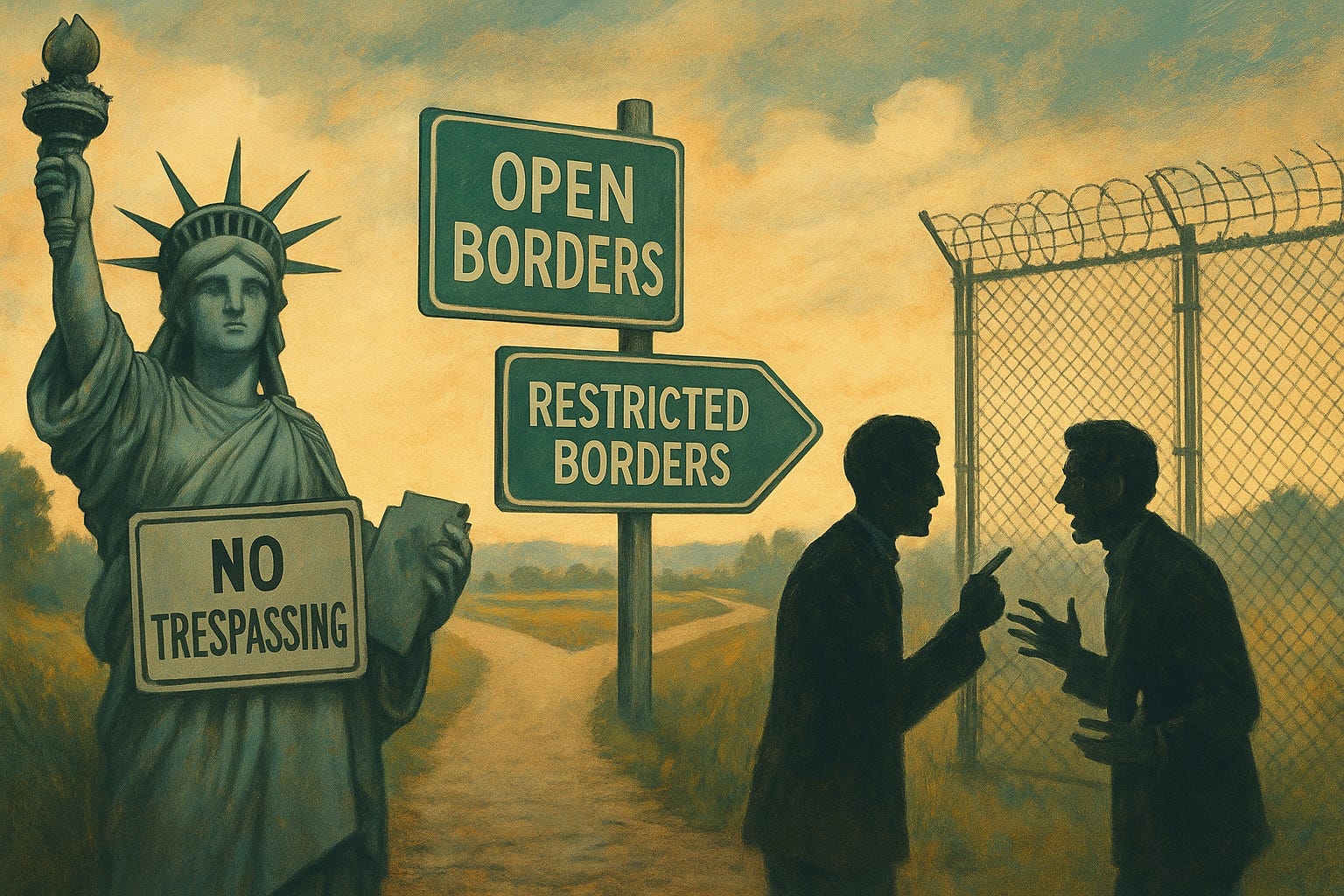
The issue of immigration has once again become a point of discussion among libertarians. At first, it might be hard to understand how libertarians—particularly libertarian anarchists—could even begin to justify the state restricting immigration in any capacity. Nevertheless, those libertarians in favor of restricting immigration—otherwise known as “bordertarians” in online circles—have offered several arguments for why their view is consistent with libertarianism. In fact, some argue that it is the libertarians who support open borders who are truly at odds with the core of libertarianism. One libertarian in favor of restricting borders is Noah Fredericks. Noah has written an X article that, in my view, effectively outlines some of the most common arguments made by libertarian proponents of immigration restrictions. My aim in this article is to show why each of these arguments is deeply flawed and ultimately incompatible with libertarianism.
Distinguishing Ownership from Possession
Noah opens his article right away by committing a fundamental error:
In a society burdened by public property— resources owned not by title and voluntary contract but by coercive taxation— the question of access to these resources becomes a defining dilemma for libertarians…
Ownership according to libertarian theory is not mere possession or control of a resource, but having a justified and enforceable claim over that resource. To own X is to have a right to X. Coercive taxation, an act of aggression, can never result in ownership. As Stephan Kinsella puts it:
Recall that ownership is the right to control, use, or possess, while possession is actual control—“the factual authority that a person exercises over a corporeal thing.” The question is not who has physical possession; it is who has ownership. Thus, asking who is the owner of a resource presupposes a distinction between ownership and possession—between the right to control (or exclude) (ownership, or property rights), and actual control (possession; economic dominion). - p. 23 of Legal Foundations of a Free Society1
This may seem like a pedantic point to start with. After all, the use of “ownership” to refer to mere possession and control was employed by Murray Rothbard:
Ownership is the ultimate control and direction of a resource. The owner of a property is its ultimate director, regardless of legal fictions to the contrary… Government ownership means simply that the ruling officialdom owns the property. The top officials are the ones who direct the use of the property, and they therefore do the owning. The “public” owns no part of the property. Any citizen who doubts this may try to appropriate for his own individual use his aliquot part of “public” property and then try to argue his case in court - p. 1277 of Man, Economy, and State with Power and Markets2
However, this is from one of Rothbard’s works primarily focused on economic theory, not libertarian theory, and he uses “ownership” more strictly to refer to justified control of a resource, not merely the physical control of it, when speaking specifically on libertarian theory. For instance, Rothbard states in The Ethics of Liberty that:
All property is therefore always "private"; the only and critical question is whether it should reside in the hands of criminals or of the proper and legitimate owners - p. 563
At first glance, this may seem like a small or trivial semantic detail to focus on, but we will see how this small error plays a pivotal role in Noah’s major misconception of the open borders position.
Public Property and Collective Exclusion:
In order to justify immigration restrictions, Noah begins by attempting to establish a principle of collective exclusion that applies to public property:
The rigorous libertarian framework, grounded in the notion that property rights are a license to exclude others from scarce resources, provides a clear answer. Once we understand public property as stolen, the principle of collective exclusion emerges as the just baseline for policy: those seeking expanded access bear the burden of obtaining consent from co-owners, not the other way around.
First—and I acknowledge this will be controversial even among my open border libertarian peers—it is incorrect to view property rights solely through the lens of exclusion. I will return to this point when it reappears in Noah’s article. For now, let’s focus on Noah’s claim that “the principle of collective exclusion emerges as a just baseline for policy” once it is accepted that public property is stolen. This is wrong. To begin with, not all public property was itself acquired through an act of theft. A house that was eminent domained was stolen. A public park that was paid for by taxpayers was funded via stolen funds from the taxpayers, but the park itself was not stolen from the taxpayers.
The proper response to learning that some public property was literally stolen by the state is to advocate that the state return the property to its rightful owner. The proper response to learning that some public property was funded using stolen funds is to advocate that the state stop funding and maintaining public property with stolen funds, and provide restitution to the individual taxpayers who were wrongfully taxed. At no point does the state's use of stolen funds create a group of legitimate co-owners with a collective right to exclude others from property they never justly acquired themselves.
What Open Border Libertarians Actually Say:
One of Noah’s biggest errors is his characterization of the open borders position:
Declaring public property "unowned" for political expediency is an unfounded appendage that implicitly endorses state acquisition while dismissing the claims of taxpayers forced to fund it.
Noah appears to interpret open-border libertarians as saying, “if the government steals John’s car, then John loses the right to it, and it’s now fair game for anyone to come and homestead the car.” This clearly contradicts basic libertarian principles of property rights. Fortunately, this is not the position held by most open-border libertarians. More accurately, the view of open border libertarians is, “if the state steals John’s car, then John still has the right to the car, not James, Andrew, or Jerry; and if the state exchanges John’s car and Jerry’s motorcycle for one boat, then John still has a right to his car, and Jerry still has a right to his motorcycle.” A state’s exchange of property it does not own cannot alter the rightful titles of those properties. Only legitimate owners have the authority to transfer title to their property. In cases where public property was taken from a clearly identifiable owner, it should be returned directly to that individual. When open border libertarians refer to public property as unowned or abandoned, they are referring to public property where there is no identified owner that had the specific property stolen from them.
Noah’s error here is to some degree forgivable. The view Noah lays out here is not my own view or the view of most of the open border libertarians I know of, but it does appear to be the view of Walter Block, who states:
But what if it is a public library? Here, the paleos and their libertarian colleagues part company. The latter would argue that the public libraries are per se illegitimate. As such, they are akin to an unowned good. Any occupant has as much right to them as any other. If we are in a revolutionary state of war, then the first homesteader may seize control. But if not, as at present, then, given “just war” considerations, any reasonable interference with public property would be legitimate - p. 181 A Libertarian Case for Free Migration4
This passage—particularly the part about any “occupant has as much right to [public libraries] as any other”—may invoke the free-for-all battle royale that Noah alludes to. With this in mind, we can now turn to what the open-border libertarian view actually entails and how it should apply in practice.
What To Do With The Public Parks—And Rotten Bananas
Let us take for instance the public park by my house. It is highly likely it was funded via taxation. However, as I have argued, what the taxpayers have a right to is their stolen tax dollars, not whatever the state exchanges for it. Imagine that someone had stolen $5000 from you, and used it to “buy” a rotten banana. Do you own the $5000 or the rotten banana? I hope the flaws in Noah’s logic are apparent. Now, economic value is subjective: if you truly value a rotten banana more than $5000, you are more than welcome to accept the banana as restitution, in which case, you would lose the right to the $5000 and gain the right to the banana. However, the key insight is that the right was originally to the $5000, and it only transferred to the banana when the victim voluntarily agreed to accept it as restitution. The exchange of property titles did not occur when the state made the exchange.
This can also be further complicated if there are more than one victim. Suppose the state steals $10,000 from John, $1000 from Andrew, and $1 from Jerry. The state then uses these funds to build a park. Could all three of them try to take ownership of the park as restitution? One could answer that yes, all three of them become co-owners of the park. However, this seems problematic. John had $10,000 stolen from him, and Jerry only had a $1 taken. How could they both come to have an equal claim to the park? This also runs into the usual problems with the concept of jointly owned property—though those issues aren’t even central to the present debate. Being a victim of theft does not nullify your right to what was stolen, nor does it transfer that right to anything else. Receiving something other than the resource stolen from you as restitution is possible and justified, assuming you as the victim have voluntarily accepted that form of restitution in a process of arbitration. This is a process no taxpayer has gone through. In addition, there is another layer of complexity to consider. The park did not spring from nothing. The state stole funds from the taxpayers, and then exchanged those stolen funds to a contractor who then built the park.
The Tales of Robber Zhi and Two Justins
Imagine two scenarios:
Robber Zhi steals $5 each from John, Andrew, and Jerry. He uses that $15 to buy a widget from Justin. Justin is unaware of Robber Zhi’s true nature. In other words, Robber Zhi is engaging in fraud as he is entering an exchange with Justin under false pretenses. As such, the exchange is illegitimate. From this, it follows that John, Andrew, and Jerry still have a right to their $5s, and Justin still has the right to his widget as he only agreed to exchange it under conditions not met.
Now imagine a different scenario:
Robber Zhi steals $5 each from John, Andrew, and Jerry. He uses that $15 to buy a widget from Justin. Justin is aware of Robber Zhi’s true nature and is intentionally trying to exchange his widget for stolen goods. In this scenario, has Justin diminished his claim to the widget by trying to exchange it for goods he knew were stolen, or has he incurred some debt to pay back John, Andrew, and Jerry?
So in the case of a contractor exchanging goods or services with the state, are they acting more like Justin in Case 1—or like Justin in Case 2? It is hard to say. Presumably, the contractor knows the state is paying them with tax dollars, but they also presumably do not view that as accepting stolen funds, and this is not simply due to their own fault. The state certainly does a good job convincing people that taxation is not theft. The contractor likely sits somewhere in the middle, but I do not find exerting mental effort in finding out exactly where he sits is relevant to the present discussion.
What To Do When No One But The State Makes A Claim
For the park by my house, the taxpayers were stolen from to fund and to maintain it, and a contractor was likely hired to build it. Does the contractor own the park? Well, the contractor is gone. I don’t know which contractor it was, how long ago it was, if the contractor is still existing, or if they would even make a claim on it if they were still around to do so. To put it simply: I am under no obligation to determine whether A is the rightful owner of X if A—or anyone on A’s behalf—is not making a claim. What I do know is that the state funded the park through tax dollars, and the taxpayers stolen from have a right to their stolen tax dollars. I also know that the state claims the park, but I also know that the state does not have a justified claim to anything. Therefore, I know the state does not own it (ownership being a justified claim). Whether the contractor could own it is debatable, but is irrelevant as they are not actively making any claim. The only group currently asserting a claim—the state—cannot justly claim anything, and the last group to have had a potential claim—the contractors—are no longer asserting one.
From this the libertarian conclusion is that the park is open to people to assert and defend their claims. Noah seems to think the implication here is that a homeless drug addict could justly claim a crowded children’s park as his trap house… his trap park. This is, clearly, not the position taken here, as the park has, clearly, already been homesteaded. Again, Noah seems to think that the position is that ALL property controlled by the government should enter some sort of free-for-all battle royal where ALL public property is up for grabs by the first person who gets there, starting… NOW! No, that is not what we are saying. We are saying that for government controlled property where there is no identified owner, then the correct way to proceed is to let people make and defend their claims to it, and see who has the highest claim of those making a claim.
Does this guarantee that the property will revert to its original chain of just ownership which originated via an act of original appropriation? Probably not, but the likelihood that any resource in 2025 is on its true justified ownership chain is highly unlikely. There have been a lot of injustices over the near 10,000 years of human civilization. The odds that any land or resource has remained on its original chain started by the first appropriator is not high. Most land and resources have been stolen at some point, probably multiple times. Luckily, nowhere in libertarian theory are we obligated to begin the endless search for the rightful owner of all property, rather, we deal with and evaluate the claims that are made in the present moment. Once someone has established a higher claim than you or anyone else, then referencing the fact that they probably did not acquire the property from its original chain is not relevant. After all, it might be on the original chain, and if not, the person in question might be the descendent of the last justified owner on the original chain. No one knows or is epistemically justified to say one way or the other. What we do know is that they have the highest claim out of anyone making a claim.
While this process may not restore the full original ownership chain—which is likely lost to history—it remains the most libertarian method of resolving claims among present actors. For some property, like the barren desert of the Mexico-US border, there might be no one there making a claim, and it follows that therefore, it is open to be homesteaded just like an unowned or abandoned resource. That is the claim. With this, I hope it is obvious that when Noah states:
To connect this to a fitting analogy: “If the government eminent domains your house, does that mean anyone has a right to live in it?” Of course not. Open borders, when viewed through this lens, are merely the redistribution of stolen property in real time and fly in the face of all theory.
he is not accurately representing the open borders view. The open-border position doesn’t imply that anyone can live in your house—it insists that you retain your right to it. Not the state. Not society. Not the taxpayer collective. You
Owners or Protectors of the Commons?
Having failed to ground a legitimate ownership claim in the taxpayer collective, Noah shifts to a different strategy—framing society as a kind of moral trustee, holding public property in escrow for its ‘rightful owners’:
To borrow a phrase common in these spheres: "If you can't identify the victim of a crime, how is it a crime?" If taxation is theft, then public property—roads, parks, welfare programs—must be viewed as stolen. These are created and controlled, not abandoned or unclaimed. In the same way that we would treat any other stolen property, society must take responsibility to protect these resources for their rightful owners: holding them in escrow, while they await rightful restitution
Let’s break this down.
"If you can't identify the victim of a crime, how is it a crime?"
If this is supposed to support the position that victimless “crimes” are not actually crimes, then I fully agree. If the implication instead is that for there to be a crime, there must be an identified victim, then I strongly disagree. Thankfully, I think Noah believes the former, though I am unsure as to what work he thinks this is doing for his argument.
In the same way that we would treat any other stolen property, society must take responsibility to protect these resources for their rightful owners: holding them in escrow, while they await rightful restitution
This is interesting. For one, protecting stolen property in escrow to be returned to its rightful owner is highly noble, but it is not a responsibility derived from libertarian principles. If I watch someone steal a woman’s purse, I am not morally responsible for ending the aggression. The aggressor is. If I do stop it, that is very praiseworthy of me, but I do not then incur the responsibility of returning and protecting the stolen goods, I am just responsible for not continuing the act of aggression by stealing it myself. Both stopping the aggression and protecting the stolen goods until they are returned are supererogatory acts, not ones out of libertarian duties. Also, it bears repeating: we evaluate the claims being made now, and have no obligation to investigate whether every piece of land or resource was ever stolen in the past, and to engage in the endless quest to return it to its original chain if it was. We are obligated to hand it to whoever has the highest claim to it of the claims being made. For land and resources that we know were stolen and know from who, then it is justified to return that land or resource to that owner or a descendant. For land and resources that we know were stolen but do not know from who or even when they were stolen, we are justified in stopping the unjust possession, but are no more obligated to hold the land or resource in escrow for the true rightful owner than we are to hold our current land in escrow on the chance that a descendant of the Native American tribes it may have been taken from might someday return to claim it. If said Native tribe does show up and makes a claim, that is one thing, but they have not, so I am perfectly justified in treating the land as my own until they do.
Perhaps Noah would object to the Native American example. While it is highly likely that the land I live on was originally held by Native Americans who had it unjustly taken from them, it is still possible that it is on its justified chain of ownership, while we know that certain state property—like roads, schools, parks, and libraries—necessarily must have a prior ownership chain in virtue of being man-made objects, and must necessarily not be on that original ownership chain in virtue of the state currently making a claim to it. Let us construct a new scenario then:
Imagine you come across a spare tire in the middle of the woods.5 A tire is a man-made object, so we know for sure that someone created this tire, and as such, someone had a claim to it. If Noah is correct, then the libertarian answer to such a scenario would be to prevent others from claiming the tire and holding it in escrow until the rightful owner makes themselves known. In other words, it would be impermissible for someone to try and incorporate the tire into their ongoing projects. This is obviously absurd. A tire in the middle of the woods may have had an owner at some point in time, but at the moment, there is no rational reason to assume that there is as it does not appear that anyone is making a claim on it, and as such, it is open to be re-homesteaded.
As for the escrow claim itself, reading this, you would think it is Noah’s position that we should restrict anyone from using public property, as we are holding it in escrow for the rightful owners and do not want to risk any depreciation of the resource. This is not Noah’s position. Despite his analogy, Noah’s position is not that public property is being held in escrow for the rightful owners. Rather, he argues that society at large—or more narrowly, the net taxpayers—are the rightful owners. That’s not a neutral holding in escrow—that’s a justification for perpetual control and continued taxation by the very agent that committed the original theft.
What’s A Right To Exclude Without A Right To Use?
To further justify his position, Noah claims that:
Either the property rightly belongs to those coerced to pay for it, or the state acquired it legitimately to begin with, which is a position that no libertarian would adopt
Finally, something Noah and I agree on. That latter position is a position that no libertarian would or should adopt. However, the same is true for the former position. What libertarians ought to do is reject this obviously false dichotomy. Suppose the state stole $100 from you and used this to purchase black tar heroin. Now lets apply Noah’s logic. Either the black tar heroin belongs to you, or it belongs to the state. Noah’s framework seems to miss the third, and most libertarian, possibility: that the taxpayer retains the right to their $100, and the state’s exchange is invalid.
Libertarian law understands ownership not as the ability for owners to use property in any way as this would lead to economic and physical contradiction, but as the legitimate authority to exclude others from their domain.
Now we are back to this exclusion vs use debate. If you are puzzled by the notion that you owning something says nothing about your ability to use it, just your ability to exclude from it, do not worry, you are not alone. As I have previously mentioned, this is something I may find dissent even among my own camp, but allow me to make my case. Even Noah agrees that ownership of an unowned resource is obtained by the first user, not the first excluder. Noah and others main argument for it being about the right to exclude and not to use is that if you said the right is to use the property in any way you want, then this would imply a gun owner is within their rights to shoot someone with their gun. As Noah argued in a post on X:
Rights can’t be about use because that would insinuate that rights are limited and secondary to some other principle anyway. It wouldn’t make sense for me to say I have a right to use a gun, as I can’t use it aggressively…
This is why no libertarian defines property rights as the ability to do whatever you want with your property, rather it is the right to to use/control the resource in ways that do not violate the rights of others. I can not help but notice that Noah does not define the right as the ability to exclude in whatever way you want, as that would lead to the same problems! Can I shoot you to exclude you? Can I exclude you from my plane by pushing you out over a pool of lava? Presumably no. I would have to exclude you in a way that does not violate your rights, and I would have to use my property in ways that do not violate your rights. In other words, just as I can not use my property aggressively, I can not exclude from my property aggressively. If Noah holds that property rights can not be about use because it is impermissible to use it aggressively, then he is going to have a hard time justifying property rights within a libertarian framework as libertarianism states that you can not justly do anything aggressively.
Problems With An Exclusively Exclusion view Of Property Rights
Viewing property rights as solely being about the right to exclude leads to some strongly counterintuitive results. For example, lets suppose that Alex owns an island that he uses as a vacation spot for several weeks during the summer.6 Lets then suppose that Brady finds a way to encircle Alex’ island with defense systems that prevent Alex from being able to return to the island. The defense systems are not set-up on the island, so Alex can not simply invoke his right to exclude Brady’s property from his own. Has Alex’ rights been violated by Brady? Yes, they clearly have, but Alex’ ability to exclude people has not been interfered with. Rather, it is Alex’ use that has been interfered with.
Noah claims on X that:
If rights were about use it would be hard to relate that right to violent defense, as that becomes somewhat unrelated to the use itself.
I am unsure of how Noah came to that conclusion exactly. To me, it seems to be the exact opposite. Suppose I attempt to burn your house down. Libertarian theory states that you are fully justified in using violence against me, or to collect restitution from me if its too late to stop the fire. Why? Is your use of the house being interfered with, or your ability to exclude people from it? The house can be burnt to the ground, and you would still have the ability to exclude people from the ashes. Thus, your justification to use violence cannot be because your ability to exclude was being interfered with, rather it has to be because the ability to use was being interfered with. Overall, damages to your property do not interfere with your ability to exclude people form the property, they interfere with your ability to use the property
How To Properly View Ownership
Shockingly, the proper way to view ownership is that excluding and using are two sides of the same coin. For unowned goods, you gain ownership via an act of original appropriation which incorporates the resource into your ongoing projects. For already owned goods, you gain ownership via voluntary exchange which incorporates the resource into your ongoing projects. If someone tries to use your property in a way that interferes, conflicts, or contradicts your use/incorporation, then you are within your right to exclude them in order to continue your justified incorporation/use, on the condition that you do not violate their rights in the process. Note that it is because two peoples incorporation of the same physically scarce resource can potentially conflict that property rights have any moral grounding. If the same physical resource could be simultaneously used by everyone in compatible ways regardless of each persons intent, then not only would assigning exclusive property rights be unnecessary, it would be immoral.
Cigar and His Lovely Cigarettes:
Noah attempts to create an analogy he thinks will illustrate why immigrants should be prevented from consuming public goods:
Consider the scenario of a thief stealing six packs of cigarettes from six individuals and dumping the contents into a bucket. The six, as the only rightful claimants, each have a just share in the restitution… Here, each victim has a rightful claim to their share. Taking some cigarettes—up to one's proportional restitution—is not theft but merely recovery. However, anyone not among the victims, or anyone who has already taken more than their share, commits a new act of aggression against all in the group.
Here Noah uses an example of a thief stealing six packs of cigarettes from six people and dumping them all in a bucket. Noah argues that only the six victims are justified in reaching into the bucket, and that they would be justified in excluding others from reaching in.
Noah thinks this maps onto immigration: the state is the thief, taxpayers are the six victims, the tax dollars and resulting public property are the cigarettes, and immigrants are those trying to reach into the bucket other than the six victims. The first thing to notice is that in Noah’s analogy, what ends up in the bucket takes the exact same form as what was stolen. Cigarettes. This setup conveniently sidesteps the deeper issue of subjective evaluation and title transfer. With the same resource, it is easy to see how it should be distributed amongst the victims. I had six packs of cigarettes stolen from me, so I am owed six packs of cigarettes from the bucket. If I take any more, I am stealing someone else’s cigarettes, if I take any less, I am not being made whole.
But, what if the thief exchanged every two packs of cigarettes for one pack of cigars? So instead of a bucket of 36 packs of cigarettes, its 18 packs of cigars. Is it the case that I am not entitled to six packs of cigarettes, but three packs of cigars? What if I value one pack of cigars very low compared to two packs of cigarettes? What if someone else in the group values one pack of cigars way more highly than two pack of cigarettes? No, I am entitled to my stolen goods. The cigarette bucket analogy only works because the same good is playing the part of both the tax dollars and the public property in the analogy, so it does not deal with the issue that the state exchanging your X for Y does not give you a right to Y, and the issue of how we would go about determining restitution if that was true given that value is subjective. Noah’s analogy avoids the real issue: the state doesn’t return what was taken—it gives you something else and calls it even. But in libertarian theory, only voluntary exchange—not forced substitution—can resolve claims of ownership.
Immigrants Pay Taxes:
Noah anticipates the objection that immigrants could gain access to property by paying taxes:
When this analogy is translated into reality, some might object that uninvited newcomers can “pay their way in” through fees or taxes
He dismisses this because:
payment without prior permission or accepted procedure does not justify entry. If someone breaks into my home and leaves money on the counter, they have still trespassed. Consent is not retroactively assumed by virtue of compensation, and likewise, immigration is not justified by economic stats alone.
But this analogy does not hold. The proper analogy would be that the thief has stolen another six packs of cigarettes from a newcomer and dumped them into the bucket. Does this newcomer have a claim on his property dumped into the bucket? Obviously yes. If Noah was correct, then no new taxpayer—whether an immigrant or not— could gain a claim to public property, and at this point, every living tax payer would be ineligible.
Hoppe It, Twist It, Pull It:
Noah goes on to advocate for a Hoppean immigration system:
Hoppe proposes a sponsorship model: immigration is permissible when a private party voluntarily assumes financial responsibility. This mirrors how migration would function in a stateless society—no one may enter private land without consent, and anyone inviting a guest onto the commons must internalize the costs. Sponsors act as proxy owners, covering liabilities and ensuring the guest does not impose on others by depleting the common pool.
To start with, the part about this mirroring a stateless society is ironic considering it is the open border libertarians who are always accused of pretending that we already live in a stateless society. In addition, Noah’s claim here rests on the idea that a libertarian society would have a commons analogous to the states commons, but regardless of if a libertarian society would have a commons, and regardless of if it would operate as Noah claims, an immigrant moving to the US is NOT analogous to a private owner inviting a guest into their private community.
What it would be analogous with is an immigrant moving into a private community and buying a house. What Noah is describing is a community where all property is individually owned, with some of the land/resources being voluntarily agreed to be treated as commons, and is maintained by the community at large. In such a scenario, the community would probably have it stipulated that if you invite a guest into the community, then you take on the responsibility of paying for their depreciation of the commons. There are some major problems with applying this view to the current world:
as previously stated, an immigrant would be analogous to a new homeowner, not a temporary guest, and another person would not be financially responsible for them.
Noah assumes this is how ALL libertarian societies would work, as opposed to just being one possible example
Lastly and most importantly, the US is NOT a private community!
What About Domestic Tax Consumers?
Noah goes on to attempt to answer the objection of net tax consumers:
In the face of this argument, some critics attempt to reduce it to absurdity by asking whether the same exclusionary logic should apply to domestic net consumers—those who live off welfare. Should they, too, be barred from using public resources and expelled? This line of inquiry, however, misses the structural and moral distinctions at the heart of libertarian restitution theory.
First, citizenship in a statist society is not entered voluntarily, nor are public goods the result of a private contractual order. Individuals are born into a regime of looting, not one of liberty. A person born under a state that monopolizes property and enforces taxation is not inherently an aggressor simply by existing or subsisting in that environment. Their consumption of public goods, in the absence of alternatives and amid unresolved claims, cannot be morally equated with the voluntary trespass of a foreign entrant who holds no stake in the common pool.
“Should” is doing some heavy lifting here. Noah was just finished arguing that the net taxpayers were the owners, so therefore, if they wanted to exclude the net tax consumers, then they legitimately could, and the net tax consumers would therefore be aggressors if they defied the net taxpayers. This just seems to be Noah recommending to the net taxpayers that they not exclude domestic tax consumers, but do exclude both foreign tax consumers and net taxpayers. It also assumes immigrants are born into a stateless society. They are not. They are born into a statist environment, and must also exist and subsist in it. They are just trying to change the environment that they are in, and if being taxed is what gave the domestic population the right to consume public goods, then it will for the immigrant. Noah’s argument rest on his desire for net taxpayers to support domestic net tax consumers, but not foreigners.
Concluding Remarks
Overall, the fundamental error with Noah’s argument is the constant equivocation between saying society has a responsibility to hold stolen goods in escrow until they can be returned to its rightful owner, and saying that society at large (or at least the net taxpayers) is the owner of the stolen goods.
A free PDF of the text can be found here: https://stephankinsella.com/wp-content/uploads/lffs/kinsella_lffs_3d_printing_mar_2025.pdf
A free PDF of the text can be found here: https://cdn.mises.org/man_economy_and_state_with_power_and_market_3.pdf
A free PDF of the text can be found here: https://cdn.mises.org/The%20Ethics%20of%20Liberty%2020191108.pdf
A free PDF of the text can be found here: https://cdn.mises.org/13_2_4_0.pdf
I thank the great Ace_Archist for this example.
While the specific example is my own, I am again thankful for Ace_Archist for putting me on the track to come up with the example.